October Market Update 2026

This month we have a bit of everything in the property news. The Reserve Bank has held the OCR, national asking rents have finally moved into positive territory, and Christchurch has had a record year for events. At the same time, one of the country’s leading property economists says the long-term pace of house-price growth may be lower than many of us have been used to.
For property owners, none of those headlines should make us rush into a decision. The right call still comes back to the property in front of us: the tenant, the condition, the rent against comparable homes nearby, and whether the numbers work over time. That is where we can roll our sleeves up and crack on, whatever the next headline brings.

OCR Held, So We Get A Pause To Take Stock
Before the Reserve Bank’s October decision, the question was whether we would see a third increase in the OCR this year. The Bank held it at 2.75%. Its message was a balancing act: inflation is still above the target range, with higher global fuel costs pushing prices up, while the recovery remains gradual and uneven.
A hold is welcome breathing space, but I would not treat one decision as a signal that mortgage rates are about to fall. The Reserve Bank’s next decision is in December, and banks also take account of wholesale funding costs and competition when setting fixed rates. If a refix is coming up, look at the actual offers and the repayments your property can comfortably carry. A forecast is only a forecast; the cash flow still has to work.
The bank-rate snapshot below is a useful reminder that the rate you pay depends on the lender and the term you choose, as well as the OCR. The shorter fixed terms shown are generally lower than floating rates, but every owner needs to compare the current offer with their own timing and cash flow.
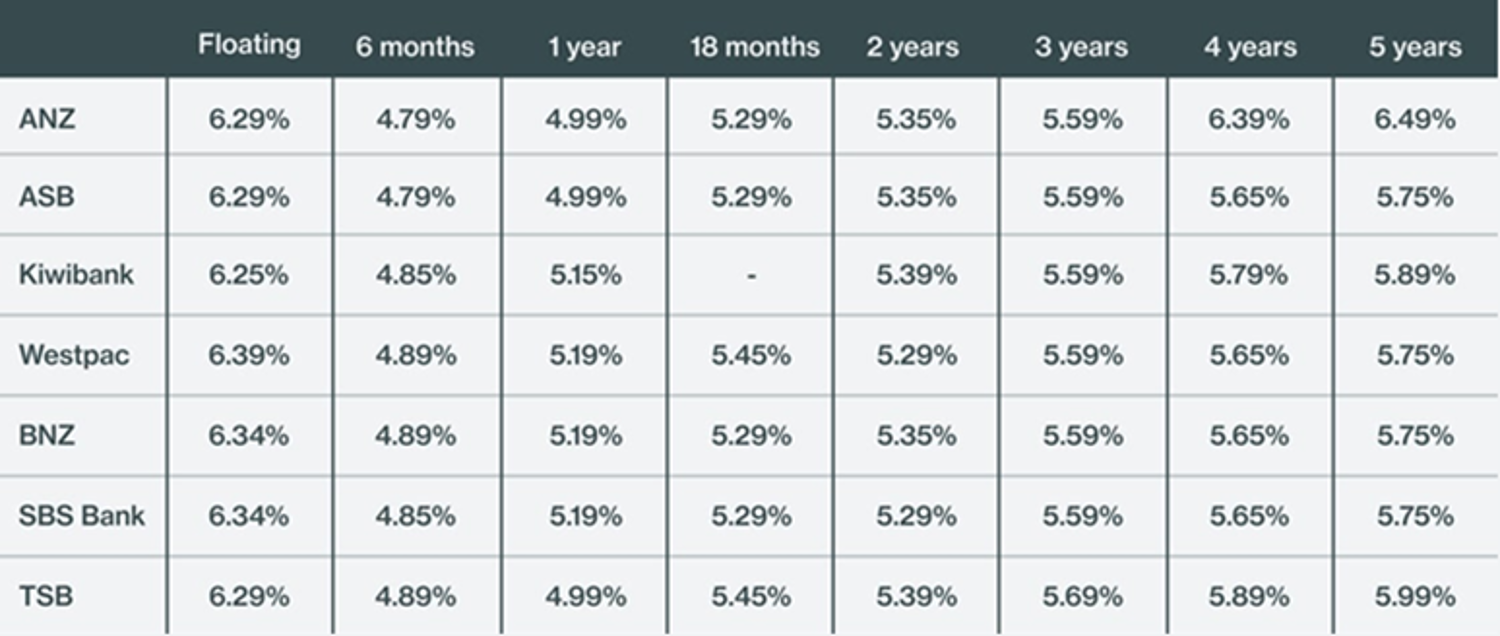
Source: mortgage-rate snapshot supplied for this update, 28 October 2026. Rates and eligibility conditions can change; check current offers with each lender.
A Different Long-term Setting For House Prices?
Cotality chief property economist Kelvin Davidson says 4% a year may be a sensible long-term guide for house-price growth, rather than the roughly 6% many people have become used to. He is clear that this is a guide, not a precise forecast. There will be years above that level and years when prices are flat or fall.
The decade just been through is a good reminder to keep the time frame in view. National values are still about 19% below their 2021/22 peak, but are around 37% higher than ten years ago. That equates to roughly 3.2% average annual growth across the decade. Davidson points to more housing supply, land-use changes and debt-to-income limits as factors that could contribute to a different pattern of growth.
For me, this reinforces a simple point: buy well, know the holding costs and make sure the property suits the tenants who want to live there. Capital growth matters, but it is not a fixed return we can build a plan around. A sound property should still make sense if prices take longer to move than we would like. When I started investing many years ago, I was told time in the market beats timing the market. Capital gains have had plenty of attention lately, but I have always seen them as the icing on the cake. For long-term investors, good tenants and rent that steadily pays down the mortgage are the foundations. Over time, that can build a reliable income stream, although rental property still needs active management.
The Election Pause Is Something I Have Seen Before
By the time I write to you again, we will be on the other side of the election. Over the years, I have found the pause button often gets pushed on new purchases and larger capital expenditure while people wait for the uncertainty to pass. Owners want to know whether it will be “same same” or a change to most things before they commit to a big decision.
That wait-and-see approach is understandable. It can slow decisions for a period, especially where a purchase or major project can be delayed without too much cost. But the election does not put tenants’ needs on hold, and it does not make essential property maintenance disappear. Once the result is known, people will still need to understand what any announced changes mean in practice; headlines and campaign promises are not the same as implemented policy.
I would not make a long-term property decision on one election announcement. Employment, population growth, housing supply, infrastructure, borrowing costs and local rental demand will keep shaping the market. My advice is to watch the policies that directly affect an owner, but keep the focus on the things we can assess today: buying at the right price, keeping a home in good order, and letting us choose the right tenant.
What is at stake for rental providers?
Labour has now set out its rental proposals. It would ban no-cause evictions, extend notice periods to 63 days when an owner or family member wants to move in and 90 days for a sale, renovation or change of use, introduce a landlord duty of care for serious hazards, and set clearer rules for property managers. It would also stop insurers requiring routine inspections more often than every six months. ACT supported restoring the ability to end a periodic tenancy with 90 days’ notice, which is now part of the law.
I understand the aim of giving tenants more security. My concern is the cumulative effect of adding more cost and risk for the people providing rental homes. No landlord wants to lose a good tenant, but when a tenancy that goes wrong becomes harder and costlier to resolve, some owners may be more cautious about taking a chance on a first-time renter, a family getting back on its feet, or someone without a perfect rental history. Those are often the people who need a chance most.
The Greens are proposing to cap annual rent increases at 2%. TOP’s proposed 1.75% annual land value tax is a separate policy. 1News reported on 29 October that TOP strongly opposes limits on rent increases, arguing that rent controls reduce housing availability. A rent cap would be a major change to how rents can respond to market conditions, while the land tax would add a further cost to holding property.
New York’s rent regulation began with wartime emergency controls in 1943; its modern rent-stabilisation system followed in 1969. It now covers about one million apartments. In 2023, vacancy was 0.98% for stabilised homes and 1.84% for market rentals, showing a very tight rental market. Those figures do not show that rent regulation caused the shortage, but they do show that a cap by itself has not solved it.
The regulated housing stock also shows a mixed record: it recorded a net gain of 21,281 units in 2025, while remaining about 117,000 units below its level 32 years earlier. The city’s report says 94% of units entering the system that year came through tax-incentive programmes. These figures do not prove rent regulation caused the long-term decline; they do show that supply, incentives and rent settings all matter.
There are also two proposed tax changes for owners to weigh. Labour’s 28% capital gains tax would apply to gains made from 1 July 2027 when residential investment or commercial property is sold; the family home and several other categories are excluded. The Opportunity Party is proposing an annual 1.75% land value tax on land value, with exemptions or deferrals potentially available to some land-rich, cash-poor owners. These are campaign proposals, not current law, but together they show how much the settings could change after the election.
The August Rent Picture: The Region Matters
Trade Me’s August Rental Price Index shows the national median asking rent at $625 a week, up $5 on a year earlier and the first annual increase since January 2025. New rental listings were down 4% year-on-year while renter interest was up 3%. The change is modest, but the supply and demand signals are worth watching as we head into summer.
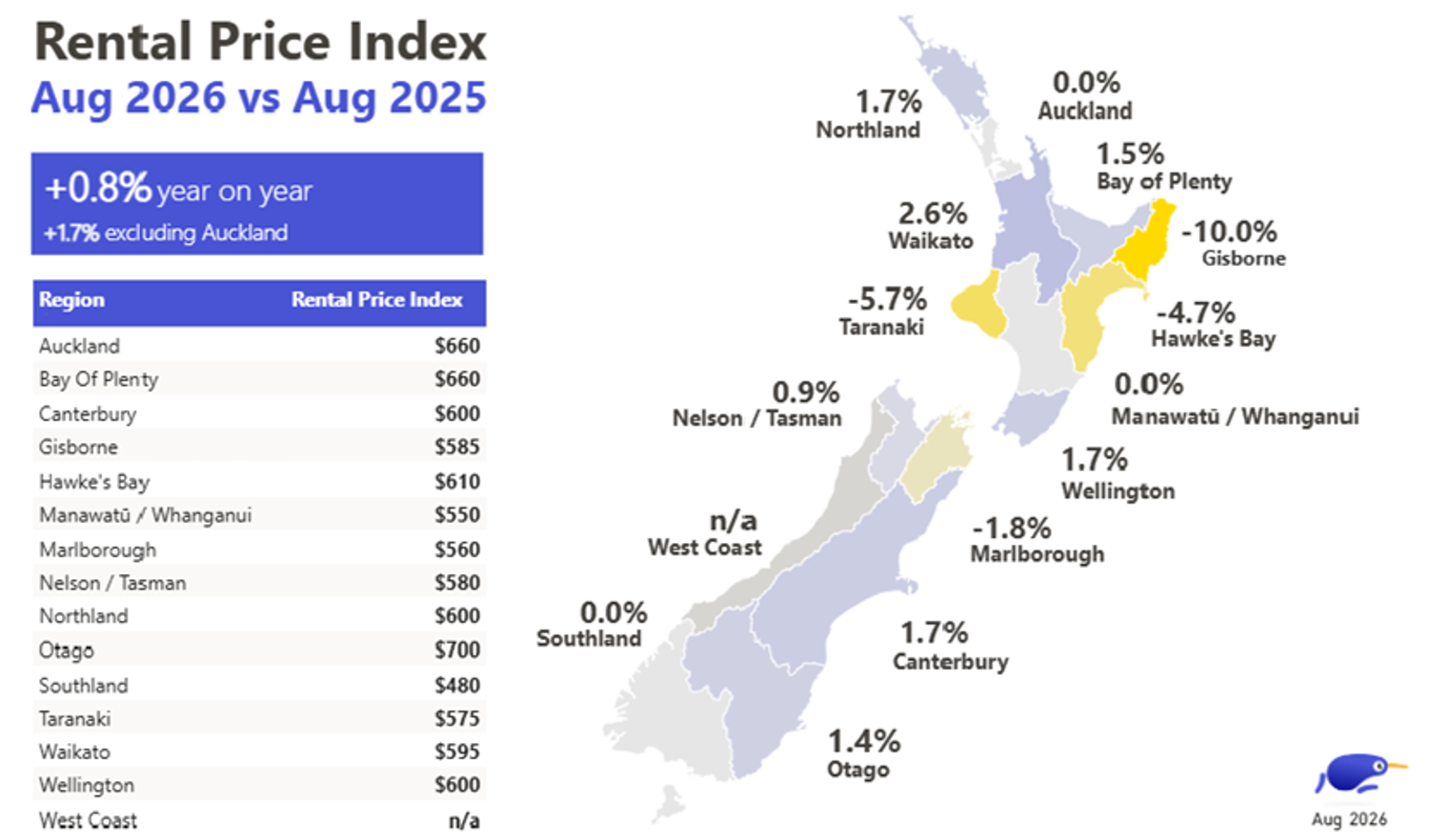
Rental Price Index, August 2026 compared with August 2025. Source: Trade Me Property.
Canterbury reached a record median asking rent of $600 a week. Three- and four-bedroom homes also hit a record $665 median, while Otago moved to the top of the regional table at $700. Nationally, five-plus-bedroom homes led price growth, with the median close to $1,100. It is a useful reminder that “the Canterbury rent” is not one number: the right comparison depends on the size and features of the property.
Trade Me remains the preferred site for rental advertising. In my view, no other site comes close to the reach it provides. From 1 December, our Trade Me advertising cost will increase by $15. No one likes a price rise, but the Premium Listing we can now offer includes a three-image preview, Premium placement for the full life of the listing rather than a one-, two- or three-week option, three-day rotations back to the top of search, a seven-day desktop search carousel, and homepage recommendations at the top of Residential for Rent. That gives owners more ways to keep a property visible throughout the campaign.
The South Island Is Not One Rental Market Either
The Press reported a separate September snapshot from realestate.co.nz. On that measure, average weekly rent in Canterbury was $597, up 5.8% over the year. Central Otago/Lakes was up 7% to $858, Otago rose 5.3% to $581, and the West Coast was up 5.4% to $478. The national average was $636, up 1.9%, with new listings 5.1% higher than the same month last year.
At A1, rent advice comes back to the home itself. A regional median is a starting point, not a rent setting for every property across Christchurch, Selwyn or Waimakariri. Bedrooms, presentation, upkeep and nearby competition all matter. A fair, supportable rent and the right tenant can protect returns better than pushing for the last few dollars and risking vacancy.
Christchurch’s Visitor Economy Has A Bit Of Momentum
Venues Ōtautahi reported an estimated $107 million in direct and indirect economic benefit to the region for the year to June 2026, up from $41.8 million the year before. Across its venues it hosted 474 events and welcomed 933,962 guests. The new One NZ Stadium was open for only the final ten weeks of that financial year, so the annual result captures just the start of its contribution.
The Press also reported that, in its first six months, the stadium had welcomed more than 465,000 people to 100 events and generated $55 million in visitor spend from outside Canterbury. Across Venues Ōtautahi, 83% of food served was sourced from Canterbury businesses and 73% of contractors were local. Those figures show how an event can carry activity well beyond the stadium gates into accommodation, food, transport, retailers and local suppliers.
That is a strong local result. It does not guarantee a lift across every property market, but it shows activity reaching well beyond the stadium gates. The first full financial year will tell us more.
What I Will Be Watching Into Summer
As we move through the election and into the busier letting months, I will be watching three things in particular:
• Tenant demand and choice. Trade Me shows more renter interest and fewer new listings in August. I will watch whether that continues through the busy season across Christchurch, Selwyn and Waimakariri.
• The homes tenants choose. Three- and four-bedroom homes set a Canterbury record median. Presentation, warmth and upkeep help, but rent still has to stack up against nearby options.
• The decisions on hold. After the election, some buyers and owners may return to plans they paused. I will watch whether activity lasts beyond a short burst.
Thank you for trusting us to manage your investment property. We will keep watching the local numbers and give you a straight answer about what we are seeing at your property. When I write next, we will know the election result so we can then continue on the investment journey together.
Hamish and the Team at A1