August 2026 Market Update

There is quite a bit to talk about this month. Canterbury rents are continuing to outperform much of the country, with Trade Me's July figures showing rents up 4.4% over the past year to $595 per week, while the national median remains flat. There are also a couple of developments that caught my attention - particularly the recent MBIE ruling around Christchurch short-stay accommodation and what is continuing to hold house prices back despite improving buyer activity.

Canterbury Rents Continue to Climb
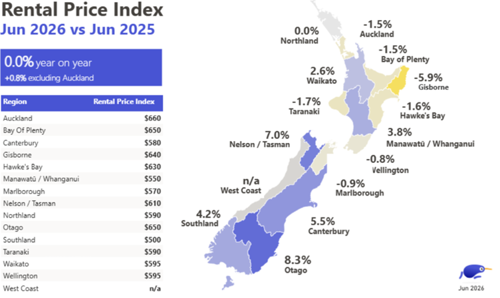
The July 2026 Trade Me Rental Price Index makes for interesting reading. Nationally, the median weekly rent remained at $620, unchanged from June and also unchanged from July last year. With inflation running at 4.1%, Trade Me points out that in real terms tenants are effectively paying less than they were a year ago.
Canterbury is a different story. Our regional median has increased to $595 per week, up 4.4% year-on-year. Canterbury, Otago and Southland are all showing solid annual rental growth, while Auckland, Bay of Plenty and Taranaki have gone backwards.
What the Rental Index Means for Canterbury Owners
The 4.4% increase is encouraging, but as always the headline number only tells part of the story. Trade Me says rental inventory increased slightly from June, although it is still 9% lower than July last year. Tenant demand remains active, but renters have more choice than they did in some parts of the market and they are taking the time to compare properties.
What we are seeing on the ground is that the market is rewarding the right property rather than every property. Presentation, pricing and configuration are becoming increasingly important. A well-presented home in the right location will still attract strong enquiry, while a tired property or one priced ahead of the market can take longer to rent.
Christchurch is particularly strong at both ends of the market
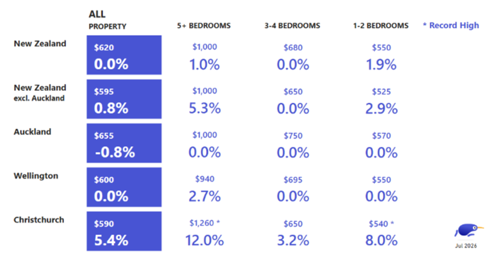
There were some notable Christchurch results in July. Trade Me recorded five-plus-bedroom homes at a median $1,260 per week, up 12% year-on-year, while one- and two-bedroom homes reached $540 per week, up 8%. That broadly lines up with what we have been seeing - demand is not the same across every property type, but good stock is still performing well.
My view
My view remains the same as last month: don't chase the headline percentage. Rent reviews need to be based on the individual property and what the local market is actually doing. In most cases, getting a good tenant into a property quickly at the right rent will beat sitting vacant for a couple of weeks trying to squeeze out another $10 or $20 per week.
Christchurch's 5,000 Airbnbs - A Ruling Worth Watching
A recent MBIE determination could have some fairly significant implications for Christchurch's short-stay accommodation market. The case involved a ground-floor unit in a multi-unit residential development on Gloucester Street. It had been consented as a dwelling but was being used for short-term guests through an online accommodation platform.
Christchurch City Council issued a notice to fix on the basis that the use of the unit had changed. MBIE upheld that view, finding that the regular turnover of short-term, paying guests was materially different from the unit being occupied as the home of a household. In practical terms, that may trigger a change-of-use process under the Building Act and potentially bring additional Building Code requirements with it.
Why this matters
• Owners of affected short-stay properties may need to notify Council of a proposed change of use and obtain written approval before continuing that use.
• A change of use can bring additional Building Code issues into play, including matters such as accessibility and potentially other compliance upgrades depending on the building.
• Christchurch City Council already has separate District Plan rules for visitor accommodation, so owners may face both planning and Building Act requirements.
• The ruling arose from a multi-unit property and does not automatically mean every Airbnb in Christchurch is non-compliant. The circumstances of each property and its consented use remain important.
Could This Shift Homes Back to Long-Term Rental?
The Press reported that Christchurch has around 5,000 Airbnb-style properties. That is a big enough number to make this more than just a technical building-consent issue. If some owners decide that the consent process, upgrades or additional compliance are simply not worth it, we could see a portion of those properties move back into the long-term rental pool.
That could add some rental supply, particularly around the central city and apartment market. I would not, however, jump to the conclusion that 5,000 properties are suddenly going to become long-term rentals or that rents across Christchurch will fall. The ruling is property-specific, and many of these short-stay properties are not the same type of homes that families are competing for in the wider rental market.
For me, the interesting part is what happens next. This is primarily a compliance issue, but it could also become a rental-supply issue. If the ruling pushes even a portion of short-stay stock back into long-term rentals, it may have some impact on supply. We will be watching for any Council enforcement response and whether that movement actually starts to show up in the market.
Why the House Sales Market Is Still Slow
The other article that caught my eye this month was Stuff's piece on the 'high-pressure lid' sitting on house prices. The basic point is a fairly simple one: there is still plenty of property for buyers to choose from. Even when buyer activity improves, prices do not necessarily move quickly if new demand is being met by a large number of listings and continued new-build supply.
That seems to fit with what we are seeing. Buyers have choice, they can take their time, and there is not the same sense that they need to chase every property. BNZ has also pointed to plentiful listings, the pipeline of new homes, higher borrowing costs, a softer labour market and election uncertainty as reasons price growth may remain subdued through 2026.
A market that rewards patience
From an investor's point of view, I do not see a slower sales market as necessarily being a bad thing. It gives buyers time to negotiate, do proper due diligence and buy on the numbers rather than through fear of missing out. In Canterbury, I would still be looking closely at location, tenant demand, achievable rent, maintenance requirements and the type of property tenants actually want.
One thing I do find interesting is that rents are currently moving faster than house prices. If purchase prices stay relatively contained while rents continue to improve, yields naturally start to look better. For an investor, that can improve the numbers even without needing to rely on significant short-term capital growth.
What I'm Watching Through Spring
As we head into spring, the next couple of months should give us a clearer picture of whether Canterbury's rental strength continues and whether the market starts to gain more momentum. These are the numbers I will be watching:
• Rental inventory - whether the number of available properties rises as spring listings increase.
• Days on market - whether well-priced rentals continue to secure tenants within a reasonable timeframe.
• Three-bedroom availability - still one of the most useful indicators of mainstream family demand in Christchurch.
• Short-stay accommodation - whether the MBIE determination leads to a measurable movement of properties from Airbnb-style use back to long-term rental.
• Sales inventory and mortgage rates - the two factors most likely to determine whether house-price growth remains subdued or starts to gather momentum.
The Bigger Picture
For me, the main point this month is that the sales market and rental market do not always move together. National rents are flat, Canterbury rents are still rising, and house prices remain constrained by plenty of stock and buyers who have time to be selective. In that sort of market, choosing the right property matters far more than trying to pick the next broad market movement.
I still favour well-located, low-maintenance homes that line up with proven tenant demand. A property does not need spectacular capital growth in the short term to be a good investment if it is bought well, rents consistently and has manageable holding costs.
A Closer Look at the Local Market
Local numbers have adjusted after the somewhat distorted picture we saw last month. The 1,259 properties showing as available in July has now fallen back to 1,095, which I think is a much better indication of the underlying stock level. The chart below shows the clear decline after the flush of student listings moved through the market.
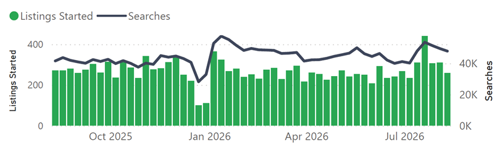
I wasn't far off last month with my estimate that the underlying number of properties available outside the student letting pool was below 1,000. With the student rush now largely through, the latest numbers reinforce that view and give us a cleaner read on where the Christchurch rental market is actually sitting.
It is still a market where good presentation and realistic pricing matter, but the overall level of available stock remains relatively tight once the seasonal student movement is stripped out.
A Note on the Coming Election
With the General Election scheduled for 7 November 2026, property is starting to feature much more prominently in the campaign and there are now some fairly clear differences emerging between the parties. Labour has confirmed a 28% capital gains tax on profits from investment property sold after 1 July 2027, while its position on interest deductibility for rental property owners is still to be confirmed. The Greens are proposing wider changes, including reversing the current interest-deductibility settings and changes to the bright-line test, alongside stronger rental regulation. Opportunity is also attracting attention with its proposed land tax and broader changes to the tax system.
There will no doubt be plenty more announced between now and November, and some of it will create headlines and short-term uncertainty. My view is not to make a long-term property decision because of one election announcement. Governments and rules change; a good property in the right location, bought well and supported by strong tenant demand, tends to remain a good property. I will keep coming back to the fundamentals - employment, population growth, housing supply, infrastructure, borrowing costs and rental demand - because those are ultimately what determine how a property investment performs over time.
We will keep watching the announcements as they come out and highlight anything that I think could materially affect rental property owners, rather than adding to the political noise around them.
As always, thank you for trusting us to manage your investment property. If you are reviewing a rent, planning some maintenance, considering another purchase or simply want to talk through what we are seeing in your part of the market, please give us a call.
Hamish and the Team at A1