June 2026 Market Update

Winter has certainly arrived across Canterbury. While frosty mornings and shorter days are now the norm, the Christchurch rental property market continues to surprise, showing little of the normal winter slowdown we would typically expect.
It’s interesting that while many headlines continue to talk about a slowing national property market, Christchurch seems to be writing its own story. Buyers remain active, tenants are still looking for quality homes, and Canterbury continues to outperform many other regions around New Zealand.
Christchurch Continues to Shine
If there is one word that best describes Christchurch right now, it is confidence. To be fair we’ve had a heap of coverage with the ONENZ stadium playing a significant role in that regard. Recent economic commentary suggests the total annual benefit to the city could be $60–80 million per year.
These major events are important not only for the immediate economic stimulus but because they help position Christchurch as a vibrant city for future investment, business and talent attraction and we are definitely seeing that.
While the stadium's visitor spending attracts attention, the longer-term benefit for investors is increased employment, population growth and business confidence. Large infrastructure projects tend to have a multiplier effect, supporting demand for both owner-occupied and rental housing over many years.
Over the past month we’ve seen multiple reports highlighting Christchurch as one of New Zealand’s strongest-performing property markets.
REINZ data released during June showed Canterbury’s median sale price reaching $725,000, matching record highs for the region, while Christchurch City has remained steady around the $720,000 mark despite a softer national market.
Perhaps even more telling is what realestate.co.nz recently described as:
“Christchurch is the headline act in the New Zealand property market.”
Canterbury has also recorded one of the strongest annual House Price Index performances in the country, demonstrating that our local market continues to benefit from solid fundamentals rather than speculative growth.
At A1 we're continuing to see well-presented properties attract strong enquiry, with quality applicants making decisions quickly when properties are priced appropriately.
Canterbury Stands Out As The Country's Strongest Metro Rental Market
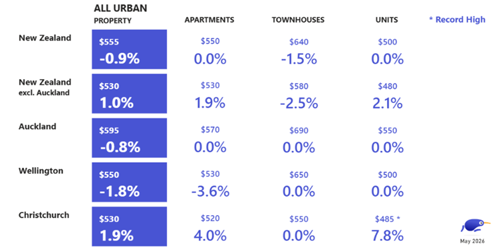
Canterbury is very much the outlier when compared with the national picture, with rents up 1.8 per cent year-on-year to $580 per week, and Christchurch’s unit market hitting record high rents of $485 per week, an 8 per cent annual increase, or around an extra $40 a week for these properties.
Trade Me Property spokesperson Casey Wylde says that over the past 12 months, rental declines have hovered between 1.6% and 4% across most of New Zealand.
"Christchurch continues to outperform the market. Rental demand there has remained strong, and the supply of units in particular hasn't kept pace which is pushing prices to levels we haven't seen before. If you're a renter in Christchurch right now, it's a tight market," says Wylde.
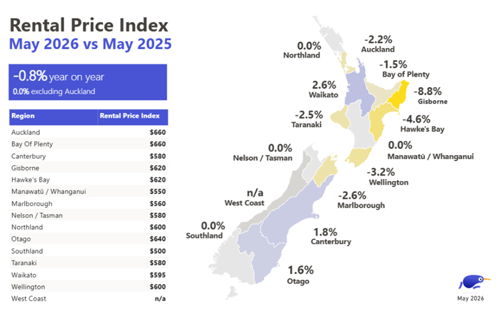
Wellington has experienced the steepest decline of any major centre, with the median weekly rent down 3.2 per cent, or $20 year-on-year to $600 per week.
Large 5+ bedroom properties in the capital fell more than 8 per cent annually to $895 per week, with tenants of these larger properties now saving close to $75 per week, suggesting this could reflect a current oversupply of such homes.
Supply Falling While Demand Grows: A Market To Watch
Despite the national price softening, the supply-demand picture is tightening.
New listings are down 11 per cent year-on-year across the country, while rental searches have grown 12 per cent over the same period.
Gisborne (+43%) and Taranaki (+32%) are the only regions recording a notable increase in new listings, with the 13 other regions Trade Me Property monitors all recording declines in May with Wellington (-21%), Southland (-16%), Bay of Plenty (-14%), Otago (-13%) and Canterbury (-12%) all seeing inventory fall sharply compared to May 2025.
“The supply story is the one to keep an eye on, with fewer landlords listing and more renters searching,” says Wylde.
“That's a combination that historically puts upward pressure on rents. If listing volumes continue to fall into the second half of 2026, we could see the modest price increases that Canterbury is experiencing start to spread to other regions.
Christchurch Is Still A Collection Of Micro-Markets
One trend we’ve spoken about previously continues to become more obvious.
There is no longer one Christchurch market. Instead, we’re seeing dozens of individual micro-markets.
Some suburbs continue to experience exceptionally strong demand while others have become far more price-sensitive.
Likewise, different property types are performing very differently. This reinforces why online rental estimates can often be misleading. Two properties in the same suburb can achieve vastly different rents depending on presentation, parking, heating, layout, school zoning and overall tenant appeal, that detail can’t be machine read.
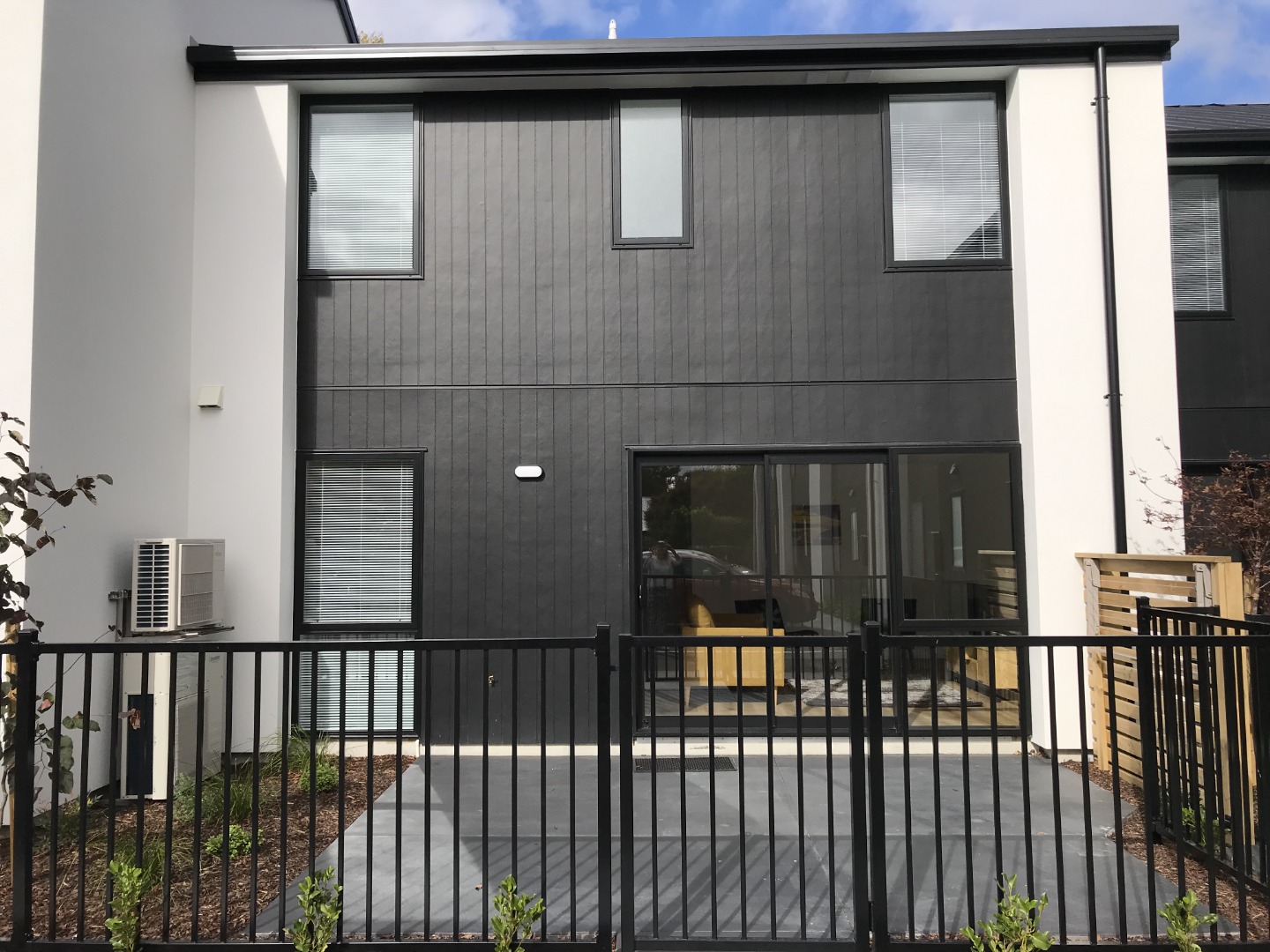
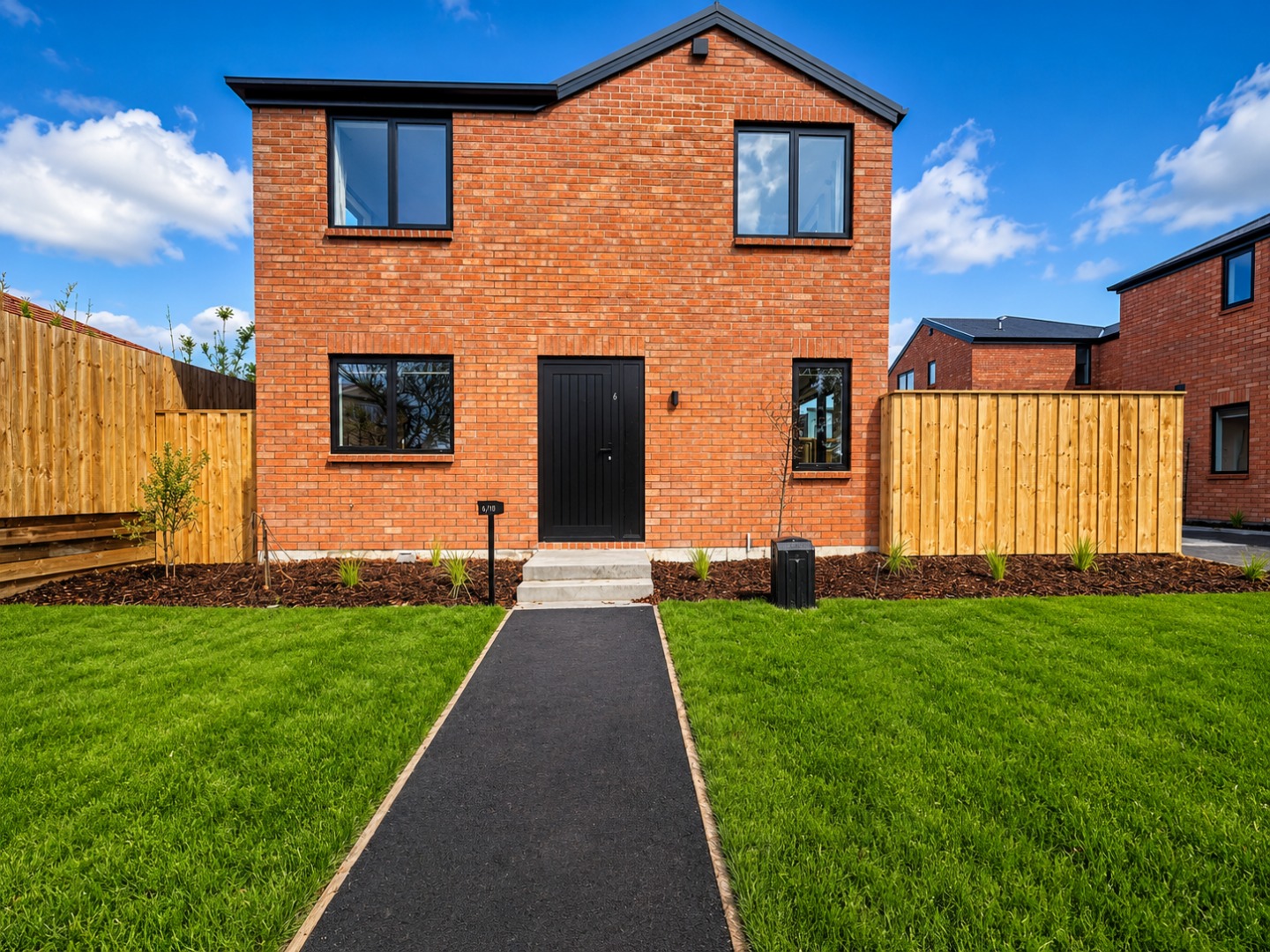
Modern townhouses close to employment hubs, hospitals and the CBD continue attracting excellent enquiry, while quality standalone family homes remain extremely popular with long-term tenants.
Stock levels across Christchurch remain below their long-term average, providing ongoing support for rental demand despite the seasonal slowdown. Lower stock levels continue to support rental demand, although not every suburb or property type is experiencing the same level of rental growth.
We're beginning to see the usual seasonal pattern emerge. Average days to secure a tenant remain largely unchanged across Christchurch, while Selwyn and Waimakariri have experienced a modest increase as fewer families choose to move during winter.
Another important factor is vacancy levels. Across our portfolio we're continuing to experience low vacancy levels, particularly for well-presented homes. While some larger family homes are taking slightly longer to lease over winter, vacancy remains well below historical averages.
OCR Watch – All Eyes on 8 July
The Reserve Bank will announce its next Official Cash Rate (OCR) decision on Wednesday, 8 July, and while financial markets will be watching closely, the overwhelming expectation is that the OCR will remain unchanged at 2.25%. Economists broadly agree the Reserve Bank is unlikely to move until it has greater confidence around the direction of inflation.
Although a July hold is widely expected, attention will focus less on the decision itself and more on the Reserve Bank's commentary. Markets will be looking for clues around whether the first increase in the OCR is likely to come in September or later in the year. Current forecasts from ANZ, ASB, Westpac and BNZ all point towards the OCR gradually increasing from its current level, with most expecting it to finish 2026 at around 3.0%, although the pace of increases will depend heavily on inflation, oil prices and global economic conditions.
Tony Alexander has also noted that the interest rate cycle has almost certainly reached its low point. While he doesn't expect an immediate jump in mortgage rates, he believes borrowers should now work on the assumption that today's mortgage rates are likely to be as good as they'll see for some time. Rather than trying to perfectly pick the bottom of the market, he continues to favour fixing for two to five years, or splitting lending across multiple fixed terms to spread refinancing risk.
We're already seeing signs that the major banks are positioning themselves for this next phase. Several have nudged longer-term fixed mortgage rates higher over recent weeks, reflecting increases in wholesale funding costs rather than changes to the OCR itself. Mortgage rates often move ahead of OCR decisions because banks price lending based on future market expectations.
For Christchurch investors, the message remains encouraging. While interest rates may gradually edge higher over the next 12 to 18 months, Canterbury continues to enjoy some of the strongest market fundamentals in the country. Stable property values, resilient rental demand and comparatively affordable housing continue to provide a solid platform for long-term investment, even as borrowing costs begin to normalise.
Winter Is The Perfect Time For Preventative Maintenance
As always, winter is a timely reminder to ensure gutters are clear, heat pumps are serviced, and any small maintenance issues are dealt with before they become larger (and more expensive) problems.
We’d suggest now is an ideal time to:
• Service heat pumps.
• Clear gutters and downpipes.
• Check roofing and flashings.
• Review insulation and ventilation.
• Repair small leaks before spring.
We've recently partnered with a Christchurch roofing specialist who provides detailed roof condition reports. A full roof audit identifies immediate repairs, medium-term maintenance requirements and longer-term planning, helping owners’ budget before small issues become expensive problems.
Preventative maintenance continues to be one of the best ways to protect both your asset and your long-term rental income.
Landlord Tip: Winter is one of the best times to assess insulation, ventilation and moisture control. Addressing these now can improve tenant satisfaction and reduce maintenance costs before spring.
Looking Ahead
With the General Election scheduled for November, we expect both financial markets and consumer confidence to fluctuate as political policies become clearer. While elections often generate headlines, property markets generally remain driven by fundamentals such as employment, population growth, interest rates and housing supply.
As always, we appreciate the trust you place in us to manage your investment property. Whether it’s reviewing potential rent on a new property, planning maintenance or considering your next investment, we're always happy to talk through your options and help you make informed decisions.
Hamish and the Team @A1