July 2026 Market Update

Canterbury’s rental market continues to outperform much of New Zealand, with rents up 5.5% year-on-year, visitor spending reaching $5.8 billion and tenant demand remaining resilient through winter. Interest rates have moved higher, but the underlying fundamentals supporting Canterbury property investment remain encouraging.

Interest Rate Update
Well, I picked this one wrong. I was left standing on the beach when the tide went out and market expectations changed rapidly at the last minute. That is investing: sometimes the market humbles all of us. The important point is not predicting every OCR decision, but understanding the longer-term direction and planning for it.
The Reserve Bank increased the Official Cash Rate by 0.25% to 2.50%, signalling that inflation pressures have eased but the economy no longer requires the same degree of monetary stimulus. This was the first OCR increase in more than three years, with the Bank remaining focused on returning inflation to target while supporting sustainable growth.
The RBNZ said: “Some further reduction in monetary stimulus is likely to be required to return inflation to the 2 percent target mid-point.”
It also noted:
“Future OCR decisions will depend on how incoming data, price-setting behaviour, and the strength of economic activity affect medium-term inflation pressures.”
Westpac described the decision as more hawkish than expected, while ANZ noted that inflation risks have eased but have not disappeared. The message is that future decisions are not predetermined and will depend on inflation, employment, spending and broader economic activity. The recent inflation reading of 4.1%, with fuel prices among the contributing factors, will add to that uncertainty.
What Does This Mean For Landlords?
Most investors are unlikely to experience an immediate jump in borrowing costs because fixed mortgage rates had already anticipated some tightening. However, investors refinancing over the next 12 months should expect borrowing costs to remain above the exceptionally low levels of recent years.
Mortgage costs are only one factor affecting rents. Rental values remain primarily driven by supply and demand, vacancy, employment, affordability and property quality. Canterbury’s rental market remains resilient, with good tenant demand and relatively low vacancy supporting well-presented investment properties. The key takeaway is that mortgage costs may edge higher, but Canterbury’s economic fundamentals continue to support rental demand and values.
Canterbury Visitor Spending Reaches $5.8 Billion
According to MBIE’s revised Monthly Regional Tourism Estimates, visitor spending in Canterbury reached $5.8 billion in the year ending February 2026, an increase of 9% on the previous year. This ranked Canterbury as New Zealand’s third-largest regional tourism economy, behind Auckland and Otago. The revised MRTE series replaces the previous tourism-spending measures and confirms the strength of Canterbury’s visitor economy.
MBIE’s latest International Visitor Survey also highlights the continued recovery of New Zealand’s tourism sector, with international visitor arrivals and inflation-adjusted visitor spending returning to 94% of pre-pandemic levels. Australian visitor numbers have exceeded 2019 levels, reaching 105%, while visitors from the United States have reached 106%. Holiday travel has also returned to pre-COVID proportions.
At A1, we look beyond property statistics alone. Strong regional economies create employment, attract residents and support business confidence. These fundamentals ultimately underpin long-term rental demand, which is why indicators such as visitor spending matter to property owners. Tourism is only one part of the market, but the latest revised data remains encouraging for Canterbury’s long-term investment outlook.
Are the Healthy Homes Standards Changing Again?
A Member’s Bill introduced by MP Helen White proposes extending the Healthy Homes Standards to require insulated curtains, blinds or equivalent window coverings in rental properties where practicable.
The proposal is based on claims that uncovered windows can account for significant heat loss and that warmer homes could reduce respiratory illness, particularly among children and older New Zealanders.
The important message for owners is: do not spend money yet. This is only a Member’s Bill. It is not law and is still awaiting its first reading. It would need to progress through Parliament before any new requirement could take effect.
We will monitor its progress and update owners if it gains sufficient support or moves closer to becoming law.
Canterbury Rents Buck the National Trend
The latest Trade Me Rental Price Index shows the national median weekly rent held at $620 in June 2026, unchanged both month-on-month and year-on-year. Search activity was nevertheless 15% higher than a year earlier, showing that renter demand remains strong even as national rents plateau.
The national result hides a clear regional split. Auckland declined 1.5% year-on-year to $660 and Wellington declined 0.8% to $595. In contrast, Otago rose 8% to $650, Nelson/Tasman rose 7% to $610 and Canterbury rose 5.5% to $580.
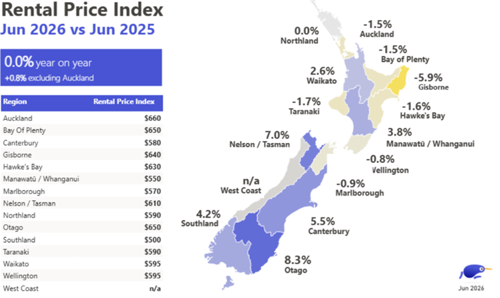
Trade Me Property spokesperson Casey Wylde said the market had found a floor, with strong listing views and watchlists showing that competition for good properties has not disappeared.
Our interpretation is straightforward: Canterbury continues to outperform the national rental market, but results remain property-specific. Correct pricing, presentation and bedroom configuration are increasingly important.
New rental inventory was down 2% from May but remained 4% above June 2025. Although overall search activity eased seasonally during winter, annual search volumes remain substantially higher. That balance has kept national rents broadly flat while allowing well-located South Island markets to continue growing.
A Closer Look at the Local Market
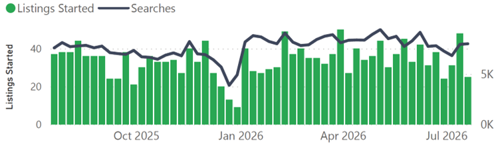
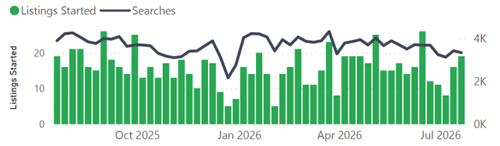
Local numbers are somewhat misleading this month. The 1,259 properties shown as available across Christchurch do not represent the market’s normal underlying supply because student letting season is in full swing. A1 alone released around 120 student properties over a two-week period, with other agencies bringing similar stock to market.
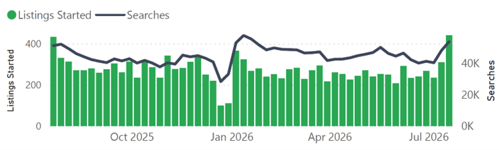
The charts show the clear uplift in new student listings and the corresponding increase in searches.
I estimate the underlying number of properties available outside the student letting pool is below 1,000. That is at the lower end of the city’s long-term range and supports Canterbury’s 5.5% annual rent increase. However, this does not mean every property can sustain a rent increase—local supply, demand, condition and pricing still matter.
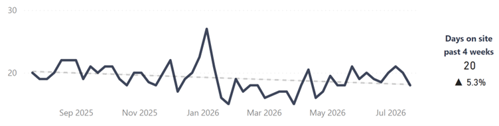
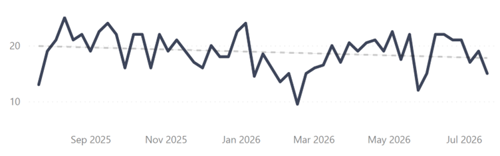
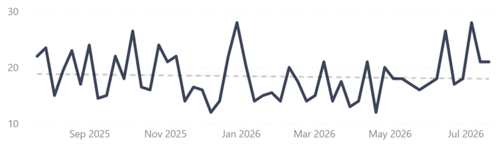
Days on market have fluctuated slightly but remain around three weeks, which is about average for winter.
For investors considering a purchase in Christchurch, this is where the data becomes particularly useful: good old supply and demand.
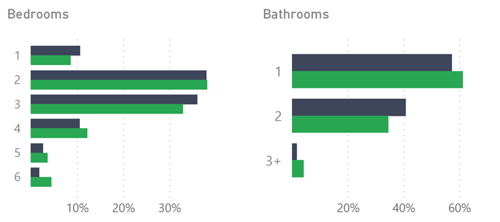
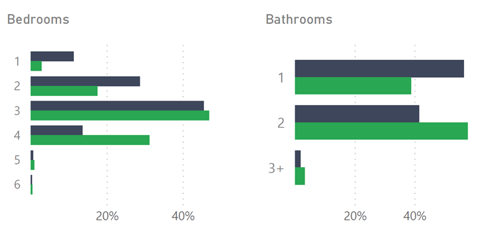
Two-bedroom supply is only just exceeding demand—the closest balance we have seen for some time. Four-bedroom properties are comparatively oversupplied, while three-bedroom homes remain in demand with insufficient stock. Based on the current numbers, my preferred target would be a well-located three-bedroom, two-bathroom property.
If I could only watch one number over the next month, it would be three-bedroom availability. To me, that's the number most likely to tell us where rents are heading next.
Selwyn
The picture is different south of the city. As winter settles into Rolleston, searches have fallen 8.9% over the past four weeks.
June data suggested a modest reduction in days on site, although I expect July figures to show that the time required to secure a tenant is beginning to stretch out.
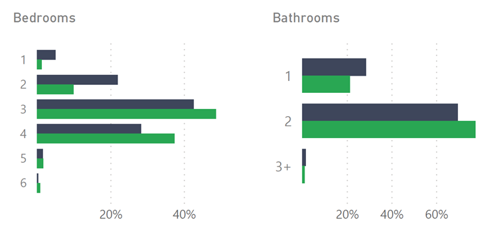
If some of Christchurch’s excess two-bedroom supply could be shifted to Rolleston—and some of Selwyn’s larger-home supply moved the other way—the overall rental pool would be better matched. Two-bedroom homes remain particularly scarce and sought after in Selwyn, while supply is more plentiful in the three- and four-bedroom categories.
Waimakariri
Waimakariri has gradually quietened over recent months, with searches down 9.9%.
Days on site have edged higher since May but have been stable over recent weeks, averaging 22 days.
Demand by property type differs again north of the city. Smaller homes currently have a reasonable level of supply, while three-bedroom properties remain the clearest target for investors based on current demand.
Looking Ahead
We are also keeping an eye on the General Election scheduled for Saturday, 7 November 2026. As the campaign develops, political parties are expected to release more detail on housing, tax and property-investment policy. Markets and consumer confidence may fluctuate as those proposals become clearer and election day approaches.
Rather than attempting to predict the political outcome, we will focus on explaining any proposed changes that could materially affect rental property owners. So far, the main housing and investment proposals have included possible changes to interest deductibility and the introduction of a capital gains tax. Other parties have released comparatively limited detail, although this is likely to change as the campaign develops.
Elections create headlines, but property performance is generally driven by fundamentals: employment, population growth, interest rates, infrastructure and housing supply. Canterbury continues to have many of the ingredients investors look for—a diverse economy, ongoing population growth, major infrastructure investment and a resilient rental market. Short-term fluctuations will occur, but we continue to see sound opportunities for well-informed investors.
As always, we appreciate the trust you place in us to manage your investment property. Whether you are reviewing a rent, planning maintenance, considering another investment or simply want to discuss the local market, our team is always happy to help.
Hamish and the Team at A1