May 2026 Market Update

It’s always interesting to reflect on what was happening this time last year. Around this time in 2025, Christchurch experienced some of its wettest conditions since MetService records began in 1943. This year has been quite the opposite, with much drier conditions already hinting at the forecasted El Niño pattern.
While we may not be talking about roof leaks this winter, it is still a timely reminder for landlords to ensure gutters and spouting are cleaned heading into the colder months.
OCR Holds Steady For Now
On Wednesday last week, the Reserve Bank Governor, Dr Anna Breman, cast the deciding vote to retain the OCR at 2.25%. Full points for transparency with the six committee members voting on whether to hike or hold, with the final vote coming in at 3–3. Interestingly, the three internal members voted to hold, while the three external members voted in favour of a hike. In that instance, the deciding vote goes to the chairperson, Dr Anna Breman, who made the call to hold.
This divergence of views wasn’t limited to the Reserve Bank’s key decision-makers. The collection of experts and economists who contribute to the New Zealand Institute of Economic Research were similarly divided on whether now was the time to hike or if it was better to wait a bit longer.
Over the course of this year, the Reserve Bank has been walking a tightrope between growing inflation concerns and a recovering economy. Until the Iran war, our economy was on the right track: inflation was edging down, and businesses were starting to feel more confident. Had this continued, the Reserve Bank could have allowed the economy to recover sufficiently and only then started increasing rates later in the year.
The impact of the war — particularly rising oil and petrol prices — means inflation has again reared its head, and those calling for a hike believe the initial price shock could feed through the economy and become a longer-term issue.
Breman erred on the side of caution, saying they want the decision to be informed by evolving data, with close attention paid to global developments. This view essentially comes down to the fact that it’s difficult to tell exactly how sticky this round of inflation will be.
In its Monetary Policy Statement, the Reserve Bank noted that inflation is set to peak at 4.3% in the September quarter, before coming down after that. That level of inflation is unlikely to be sustainable from the Reserve Bank’s perspective, suggesting further OCR adjustments remain likely at some stage.
The speed at which the OCR rises from this point will be determined by how long that increased figure remains. The bottom line, however, is that we are looking down the barrel of a series of hikes — whether that happens at the next OCR decision on July 8 or in September as widely predicted remains uncertain.
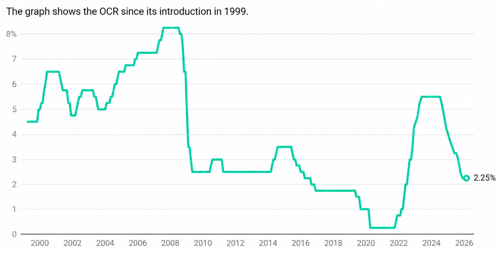
Most bank economists have warned that the period of low interest rates is coming to an end, and we can expect a period of higher rates for some time. The thing to watch from this point is how aggressively the Reserve Bank moves to lift those rates when the time comes. If inflation starts to look particularly sticky, it could send a message to the wholesale market that rates might need to rise faster than expected.
But as the Reserve Bank pointed out, there is still so much global uncertainty linked to the war in the Middle East, making definitive calls difficult right now.
Understanding Seasonal Shifts
The period between June and September is often viewed as a quieter time in the rental market, but in reality, it is simply a more balanced and steadier environment.
Tenants are still actively searching for homes and relocating during winter. The urgency may soften slightly, but demand certainly does not disappear.
Where some landlords run into trouble is reacting too quickly to seasonal changes. Reducing rent unnecessarily, rushing through tenant selection, or postponing maintenance can all impact the long-term performance of an investment property.
More stable market conditions reward proactive, measured decision-making. Here are a few things that come to mind about successful management in the quieter months:
1. Set Rent According to Today’s Market
Extended vacancy can have a far greater effect on returns than adjusting rent slightly to meet market conditions.
A property priced correctly from the beginning is more likely to:
Generate enquiry sooner
Minimise vacant periods
Maintain reliable rental income
Understanding what tenants are realistically prepared to pay in the current market is essential. Accurate data combined with local experience helps us strike the right balance between competitiveness and value.
The goal is not to discount unnecessarily, but to position the property effectively within the current market.
2. Good Tenants Add Long-Term Value
When the market slows slightly, it can be tempting to prioritise speed over quality when filling a vacancy. At A1, we believe securing the right tenant is always more important than simply filling a vacancy quickly.
However, selecting the right tenant remains one of the most important ways to protect an investment property.
Quality tenants are more likely to:
Pay rent consistently and on time
Remain in the property longer
Take care of the home
On the other hand, a poor tenancy can create costs and stress that outweigh any short-term benefit of securing a tenant quickly.
Careful application screening helps create long-term stability while still managing vacancy risk.
3. Proactive Maintenance Preserves Property Performance
Maintenance is sometimes pushed aside during winter as landlords focus on managing expenses. Unfortunately, delaying small issues often leads to larger and more costly problems later.
A proactive approach includes:
Fixing minor repairs early
Checking heating and insulation are functioning properly
Keeping the property warm, comfortable, and well-presented
Properties that are well maintained tend to attract stronger tenants, retain them longer, and support better rental outcomes over time.
Maintenance should be viewed as an investment in protecting the asset and its income potential.
4. Consistent Lease Management Reduces Downtime
Trying to perfectly predict the market is difficult and rarely necessary.
What landlords can control is how proactively their tenancy is managed.
This may include:
Planning lease renewals in advance
Reviewing rental levels regularly
Keeping open communication with tenants
Forward planning helps minimise vacancy gaps, improves renewal opportunities, and creates more stable income throughout the year.
Consistency is often the result of preparation.
5. Communication Matters
For many landlords, uncertainty can feel more challenging than the market conditions themselves. During quieter periods especially, practical guidance and experience become even more valuable.
And To The Local Market…
Last time I reported to you, I described the Christchurch rental market as sitting in something of a “sweet spot” — and pleasingly, that still appears to be the case. Available properties have increased slightly compared to last month, but stock levels remain around 200 below long-term averages.
While winter traditionally brings a slightly more measured market, Christchurch continues to show strong underlying demand compared with many other regions around New Zealand.
Stock levels remain below long-term averages in many suburbs, and well-presented homes in desirable school zones and commuter-friendly locations continue to attract consistent enquiry.
We are also continuing to see “micro-markets” emerge across Christchurch, where some suburbs and property types are performing noticeably stronger than others. This reinforces the importance of accurate pricing, strong presentation, and local market knowledge when managing investment property.
One trend we continue to monitor closely is tenant preference shifting toward warm, healthy, low-maintenance homes. Properties with efficient heating, modern presentation, practical outdoor spaces and secure garaging are consistently attracting stronger enquiry and better tenant retention across Christchurch.
What continues to emerge across Christchurch is a series of “micro-markets”. Some suburbs and property types are still experiencing strong tenant demand and upward rental pressure, while others are seeing increased supply and flatter conditions.
The national median weekly rent has recorded its first month-on-month increase since November 2025, rising by $5 to $625 in April, according to the latest Trade Me Property Rental Price Index.
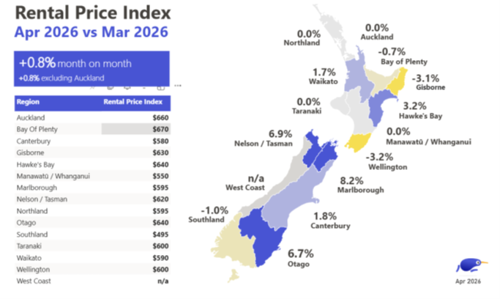
While rents are still $5 cheaper compared to the same time last year, this figure masks the underlying pressure in the market. Trade Me Property spokesperson Casey Wylde says a mismatch between supply and demand is the main reason for the intensifying competition.
"Nationally, the number of rental properties available was down by 5% in April compared to last year, while demand was up 8%. This is creating a more competitive environment for tenants, and we expect this to put upward pressure on prices in the coming months."
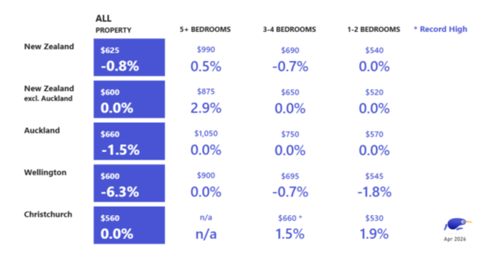
Christchurch families are facing a highly competitive market, pushing the median weekly rent for a three-to-four-bedroom house to a new record high of $660.
"While the broader rental market is cooling down, it's a very different story for families needing more room," says Wylde. "Quality family homes are still highly sought after. In Christchurch especially, the demand for these mid-to-large sized houses is so strong that we're seeing prices hit new peaks."
Across our management portfolio, we continue to focus heavily on maintaining low tenant churn rates, which support consistently high occupancy levels.
Despite the seasonal slowdown, we are still seeing well-maintained properties lease efficiently when priced correctly and presented well to the market.
Winter Checklist for Landlords
Heading into the colder months, now is a good time to:
Service heat pumps and ventilation systems
Check gutters and spouting
Review insulation and moisture control
Address small maintenance items before they become larger issues
Review current rental levels against market conditions
Plan ahead for upcoming lease renewals
Small proactive steps now can help reduce vacancy, improve tenant retention, and protect long-term property performance.
As always, we appreciate the trust you place in us to manage your investment property. Whether you need advice around rents, maintenance planning, market conditions, or future strategy, our team is always available to help.
Hamish and the Team @A1