March 2026 Market Update

Now, I’m not a fully-fledged, one-eyed Cantab, but I have to admit the region is really hitting its straps this year. In late March, Christchurch finally received the keys to its new $683 million stadium after waiting patiently for 15 years. Since opening, events have already sold out. The planned events so far include the sold-out opening concert Once in a Lifetime, the All Blacks v France test match (sold out), Black Ferns v France, Robbie Williams, and Foo Fighters, just to name a few.

Adding to that, a new train service is also launching for Crusaders games, taking fans from Rolleston and Rangiora to the stadium for $49 return. This will surely be the catalyst for commuter light rail in the city going forward. That would be an absolute game changer—note the pun—for the region, fully cementing that Christchurch is the place to be.
It’s the economy that is really gaining momentum here. The South Island is powering ahead with 5.2% GDP growth, almost double the North Island’s 2.8% increase.
Auckland, which accounts for 37.5% of national GDP, grew just 2.1% in the year ended March 2025.
Canterbury has also secured back-to-back wins on the ASB regional economic scoreboard, outperforming nearly every region in jobs, retail spending, housing activity, and population growth.
ASB Chief Economist Nick Tuffley said, “Canterbury has delivered back-to-back wins to close out the year, supported by strong dairy incomes, steady jobs growth, resilient consumer spending, and the recovery of the tourism sector. The region enters 2026 in a very strong position.”
Let’s hope the fuel crunch doesn’t put the brakes on the country just as we are starting to gain a little momentum.
Election 2026
As promised, I will keep an eye out for any policies being announced by our political parties that may have an effect on property investors going forward. This month, the Greens have revealed their plans to “save the rental market” with the Renter’s Rights Bill. It promises to cap rent increases at 2%, reverse no-cause evictions for rental stability, and introduce a Rental Warrant of Fitness to address gaps in the Healthy Homes Standards.
To prioritise housing as a necessity, not an investment, the Greens would reverse National’s billions of dollars of tax cuts for landlords and property speculators, so first-home buyers have a better chance of putting down a deposit without losing out to wealthy investors.
These are the Green Party’s proposed policies, presented in their own words, but the very terminology grates on me, let alone the sentiment. It is fair to say, from a practitioner’s point of view, that last time untested changes were made to the rental laws, it didn’t go well. Landlords—mainly Kāinga Ora—faced huge issues with anti-social tenants they could do little about, and rents increased due to additional compliance costs.
Rent caps are a proven recipe for shortages. Around the world, rent control reduces supply, discourages investment, and ultimately makes housing harder to find and more expensive.
A rental “warrant of fitness” means more red tape, more compliance costs, and fewer properties available to rent. It puts bureaucrats in the position of deciding whether homes stay on the market.
New capital gains, wealth, and trust taxes would target thousands of families who have worked hard, saved, and invested for their future. And whatever they can’t tax, they’ll borrow—pushing up interest rates again and leaving the next generation with the bill.
Meth Regulation Changes
The Residential Tenancies (Managing Methamphetamine Contamination) Regulations 2026 will come into force on 16 April 2026. These regulations clarify what to do when a rental property is contaminated with methamphetamine (“meth”).
The new regulations set out:
the maximum acceptable and habitable thresholds for meth residue levels
guidelines for when a property must be decontaminated
guidelines for when a tenancy can be ended due to meth contamination
guidelines on how testing and decontamination must take place
landlords’ responsibilities for managing meth contamination
guidelines on dealing with goods abandoned by tenants in contaminated properties
In a nutshell:
A property is contaminated if any part of it has meth residue levels above 15 µg/100 cm². These areas must be decontaminated until levels are at or below 15 µg/100 cm². Contamination is determined on a room-by-room basis. For example, if a bedroom is above 15 µg/100 cm² but the kitchen is below, only the bedroom needs to be decontaminated.
If any part of the property is tested and found to have meth residue levels above 30 µg/100 cm², the property is deemed uninhabitable. This is the maximum habitable level set out in legislation.
Landlords are required to arrange detailed meth testing if:
Police or a local council notifies them that meth has likely been manufactured at the property, or
a valid screening assessment shows contamination (at least one area above 15 µg/100 cm²), and the landlord is made aware of these results
There is quite a lot of detail to digest—if you want to know more, feel free to give Hamish a call.
Investment Insights
Yes—but only if you buy the right product in the right area.
I love a good data set, and what’s really interesting is good old supply and demand 101. You only need to look at the current fuel situation to see that in full action. Reviewing the supply and demand summaries from late December to 22 March, there are some clear differences across greater Canterbury.
In Christchurch City, the most searched rent bracket is $600–$700, with demand matching supply. Next is $700–$800, where supply also meets demand, making up around 20% of the market. Interestingly, the $500–$600 bracket shows supply exceeding demand, while the $800–$900 bracket shows demand exceeding supply.
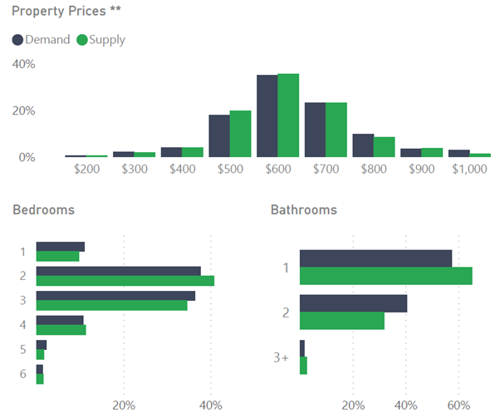
Property types in demand remain three-bedroom, two-bathroom homes, which is no surprise. Meanwhile, two-bedroom, one-bathroom properties still have solid supply.
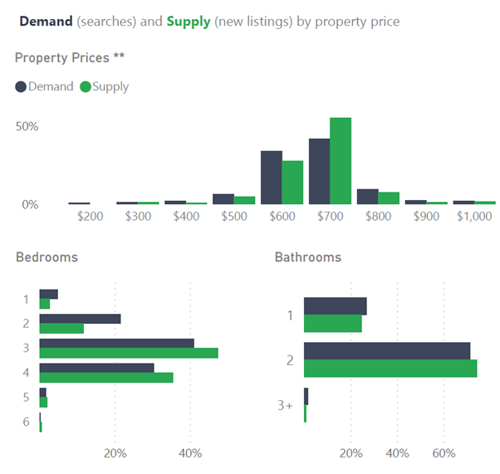
In Selwyn (Rolleston and Lincoln), the picture is different. Rolleston was softer last winter, with plenty of supply and rents dropping by around $20 per week, but this has now recovered to pre-winter levels.
The $600–$700 bracket remains the most in demand, with supply slightly exceeding demand. In the $700–$800 range, supply is around 10% ahead of demand.
In Selwyn, demand shifts toward two-bedroom, one-bathroom properties, which currently outstrip supply by around 10%, while three- and four-bedroom homes are more plentiful.
In Waimakariri (including Rangiora, Kaiapoi, Ravenswood, and Pegasus), the data is more subdued but still insightful. The sweet spot remains $600–$700 per week. Demand in the $700–$800 bracket sits slightly below supply. Similar to Rolleston, demand for two-bedroom, one-bathroom properties exceeds supply.
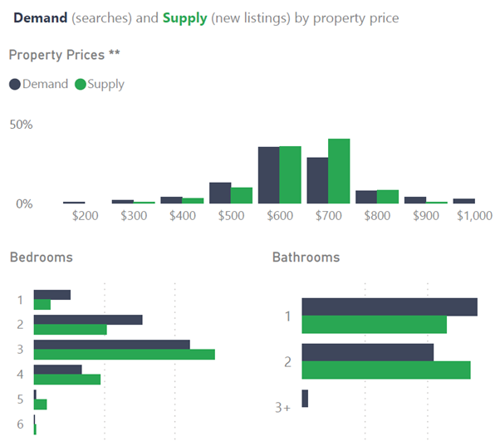
If I were buying, I’d target a property that rents for $600–$700 per week—ideally a three-bedroom, two-bathroom home in the city. In Rolleston and Waimakariri, that would more likely be a two-bedroom property, which would sit in the $500–$600 range. Vacancy rates for these property types are expected to be lower based on current data.
Local Market Stats
As mentioned earlier this year, the market has delivered a few surprises since January and is stronger than predicted.
April is always an interesting time with the change of seasons. As we head into winter, we typically expect movement to slow as people prioritise staying in warm, secure homes. That was the case last year—but this year feels different.
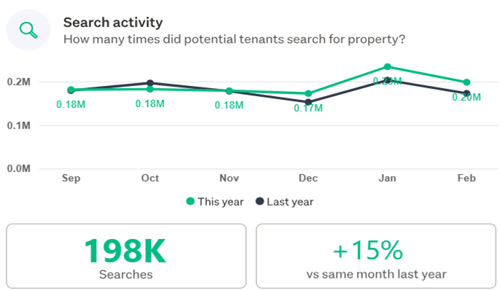
Listings are down by 130 properties compared to this time last year and up just 18 since last month. However, search activity is up 15%. Fewer properties and more searches—that’s a positive signal.
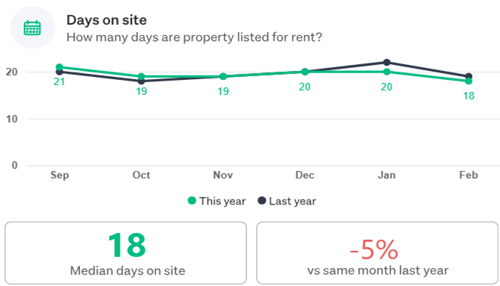
The average time to rent has dropped to just 18 days. While not the eight days we once saw, it’s a solid improvement from 23 days this time last year.
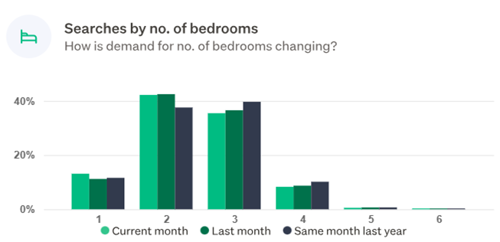
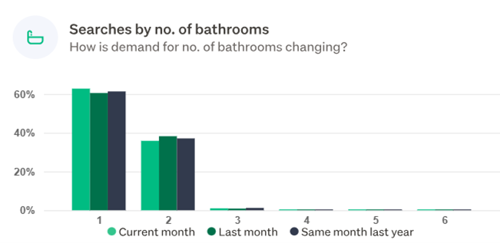
Search activity continues to favour two- and three-bedroom homes, mostly with one bathroom. Properties with two bathrooms account for just under 40% of searches, compared to over 60% for one bathroom.
Price-wise, we are holding steady. As mentioned last month, we appear to be sitting at a sweet spot of equilibrium in the market.
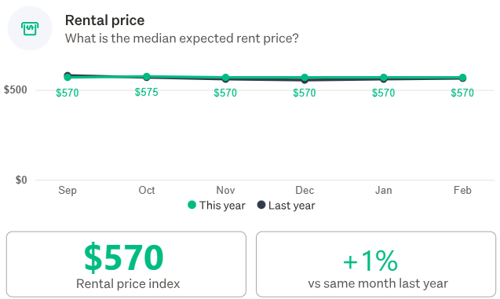
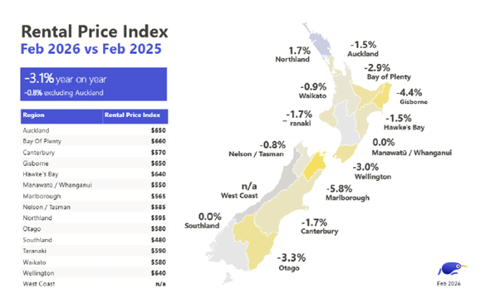
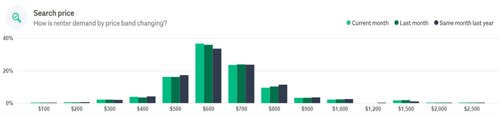
We’ve seen an increase in searches in the $600–$700 range compared to both last month and this time last year. This has come at the expense of the $500–$600 bracket, suggesting some renters are willing to spend a little more. The $700–$800 bracket has remained relatively flat.
Anyway, you’ve probably had enough of my commentary for now. As always, we truly appreciate your business. The team and I are always just a phone call away. We’re always available for a chat and happy to share our experience and knowledge wherever we can help.
Hamish and the Team @ A1