February 2026 Market Update

As we progress into March 2026, Christchurch's property market presents some timely opportunities for investors. The year has started stronger than I expected. This has had an effect on stock levels and days on market — and yes, I’ll talk about rents soon.
I know the sales market is running very hot. Open homes are attracting good numbers, and a lot of properties have multiple bidders at auction. I’m told there is a good mix of investors and new home buyers in the market. We’ve certainly seen this, with nine new properties crossing my desk last week alone.
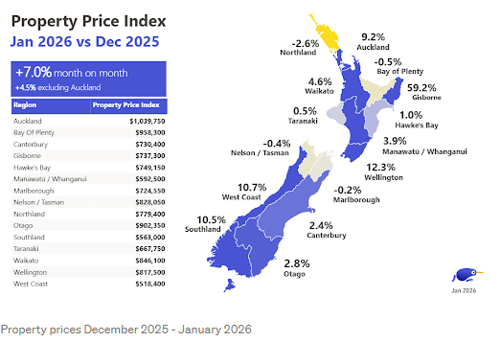
Prices are trending upwards here too.
Stock Levels
Let’s get straight into stock levels this month, as they are intriguing me. We have around 980 properties available throughout the city, excluding Selwyn and Waimakariri. That number seems low to me — and good news for many.
Nine hundred and eighty is well below the long-term average for the city, sitting about halfway between the average and the low stock levels we saw in Q3 and Q4 of 2024. Supply and demand are the biggest drivers of market rent and days to rent.
Should we see rents move soon? Not quite yet. While we are seeing shortages in some property types, there is still a good supply across the board. Around 35% (pushing 36%) of available stock is two-bedroom properties, so there is still solid supply there.
From my perspective, we are in a bit of a sweet spot for both owners and tenants. Rents are holding firm, with small increases in some property types. The median rent is now $5 cheaper than the same time last year — so very close.
The “sweet spot” is this: days to secure tenants are coming down, vacancies are decreasing, and rents are firm, with little chance of softening given current stock levels and demand. For tenants, it’s also positive — there is still enough supply to prevent the runaway rent growth we’ve previously seen. The market is well balanced at the moment, perhaps slightly in the owner’s favour.
Owners in Auckland and Wellington don’t quite share the same experience. The median rent in the Wellington region plummeted by 7.4% compared to January last year, landing at $625 per week.
Official Cash Rate (OCR)
We are on hold — no great surprises there. I don’t think anyone was predicting anything different. There are mixed views on what happens next.
The bank’s Monetary Policy Committee said annual price inflation was above the 1–3% target band at the end of 2025, sitting at 3.1%. However, households “remained cautious in their spending” and inflation was expected to fall. They went on to say:
“Inflation is most likely returning to within the committee’s 1–3% target band in the current quarter. The committee is confident that inflation will fall to the 2% midpoint over the next 12 months due to spare capacity in the economy, modest wage growth, and core inflation within the target band.”
I’m not entirely sure whether that’s optimistic thinking, as nothing I see gives me much confidence that inflation will return to 2% quickly. That said, if it does, it would be welcome news. The RBNZ went on to say, “If the economy evolves as expected, monetary policy is likely to remain accommodative for some time,” which effectively means that if markets behave, they will leave the OCR unchanged.
If you follow Tony Alexander, he has offered some great insights into where the OCR and mortgage rates may head. I’m happy to leave that to the experts, but at present, the two- to three-year fixed rate seems to be the most commonly recommended.
It’s Election Year
Oh, the joy. The party spin doctors are warming up — you can feel it.
I read that Labour was even attempting to politicise the OCR announcement, with its finance and economy spokesperson saying the decision to keep the OCR unchanged reflected “the uncertainty and anxiety many households and businesses are feeling under National's economic mismanagement.”
Each to their own. Personally, the $92 billion — that’s $92,000,000,000 — of debt accumulated gives me more anxiety than the OCR being on hold for one period.
We usually sift through the rhetoric to see what each party is offering investors and landlords. With policy announcements beginning to surface, the distinctions matter — often in more subtle ways than first appear. There is no universal “right” option for every investor, but the contrasts are clear: Labour proposes a CGT from 2027 while retaining interest deductibility; National prioritises cashflow and opposes new CGTs; and the Greens seek broader reform of housing and wealth taxation.
Labour – Targeted Capital Gains Tax, Interest Deductibility Retained (For Now)
Labour has confirmed it will campaign on a targeted Capital Gains Tax (CGT) applying to investment and commercial property, with the family home excluded. The tax would apply to gains accrued after 1 July 2027, with properties valued at that date and net gains taxed at 28% when sold. Losses would be ring-fenced and carried forward, meaning no refunds and only offset against future housing gains.
While Labour has not ruled out changes to interest deductibility in the future, its current position retains it — a point many investors may see as favourable compared to removal.
National – Protect Cashflow and Reject New Capital Gains Taxes
National continues to back private housing investment by retaining 100% interest deductibility and maintaining the two-year bright-line test. It opposes Labour’s proposed CGT, arguing it would discourage investment and tighten rental supply. The party’s focus is on supporting investor confidence and preserving cashflow, although critics contend that broader supply-side reforms must accelerate to address housing shortages effectively.
The Greens – Wealth Tax and Enhanced Renter Protections
The Greens approach housing primarily as a social good rather than an investment vehicle. Their platform proposes a 2.5% annual wealth tax on net assets above $2 million, which would include property equity. Properties held in trusts would face a 1.5% annual tax with no threshold.
They also advocate removing interest deductibility, strengthening renter protections, considering rent controls, introducing rental WOFs, and establishing a National Landlord Register. While intended to curb speculative demand and improve affordability, these proposals would introduce additional compliance obligations and regulatory complexity for investors.
And I suspect this is just the beginning.
It Pays to Check
From the caution files this week: if you’re looking at a new property — either directly from a developer or through their agent — please obtain an independent rental appraisal.
We had a client approach us last week with an appraisal supplied by the selling agent’s firm, which also has a property management arm. It was plainly misleading — and that’s me being polite. It was hundreds of dollars away from what would have been true market rent.
Being 100% independent gives us the luxury of being honest and calling it as we see it.
As always, we truly appreciate your business. The team and I are just a phone call away. We are always available for a free chat and are happy to share our experience and knowledge wherever we can be helpful.
Hamish and the Team @ A1